
Written by Brendan Maslauskas Dunn for unicornriot.ninja, published on May 17th & 24th under CC-BY-NC-SA 3.0
Read Part 1 and Part 2 on Unicorn Riot
A bitter, protracted labor dispute in the poverty-stricken country of Cambodia has revealed the true nature of a brutal system where wealth and power is violently held onto by a tiny ruling elite.
At the center of this struggle lies a beleaguered union at NagaWorld, the nation’s largest casino. Workers in the Labor Rights Supported Union of Khmer Employees at NagaWorld (LRSU) have been on strike for a grueling 17 months. In that time, union members have embraced a daunting struggle with a powerful, intransigent employer, and a notoriously authoritarian government. They have been pushed to the limits of physical and mental exhaustion.
The road to victory for the LRSU is incredibly narrow, and the future wildly uncertain. Union members routinely face intimidation, surveillance, and violence from the authorities, and union leaders are currently in prison, or are awaiting sentencing in an unforgiving legal system. But the LRSU membership is a defiant and audacious group that refuses to give up.
Emerging from the Chaos
September 11, 2022. It’s a typical day in Phnom Penh, the sprawling, densely populated capital of Cambodia. It feels as if the mid-morning sun grabs the city with outstretched arms, and pulls it ever closer. Over 400 union activists from a dozen different unions, LRSU the most prominently represented, line the street opposite the Ministry of Labor and Vocational Training. They bring with them a petition to deliver to the ministry demanding an end to the union busting which has besieged the labor movement throughout the pandemic. It’s unlikely the ruling Cambodia People’s Party will do anything in response to it, but the unions present are determined to fight.
After a number of passionate speeches by union leaders are given, workers start to head east through the city. Marches such as this are rare here, and in the past were violently suppressed by the authorities. The union activists know this and take a calculated risk. As the protest spills out into the streets, it becomes evident rather quickly that the police are ill-prepared to respond to this. The steady flow of tuk tuks and motos grinds to a halt.The police frantically scramble to reassert their authority.
The police form a human wall to prevent the unionists from moving forward, but the momentum of the crowd and sheer willpower of the union activists push the police back. Added police reinforcements stop them from moving forward. Amidst screams of opposition and terror emanating from the crowd, the police start to beat the demonstrators with their fists, and walkie talkies. It’s a terrifying display of brute force.
One worker, beaten into shock by the police, slumps to the ground and throws up. His skin turns pale as sweat drips down his face. His eyes roll back into his head, and he collapses on the burning hot pavement. Union members rush to his aid. One grabs onto him and wraps her arms around him. Several others frantically fan their picket signs to cool him down. A deep feeling of panic and fear is palpable, and it grips the crowd in its clutches.
And just at that moment, teetering at a precipice of absolute police terror, the workers collectively wrench free from the chaos. They regather and reroute the march, ever determined to continue across the city to their final destination at NagaWorld.
Out of the throngs of the crowd emerges LRSU president Chhim Sithar alongside other unionists. They plead with the police and a Cambodia People’s Party (CPP) city official who shows up, worried that another attack by the authorities is iminent. Short, with piercing eyes, and a calm demeanor, she walks undaunted, and with purpose.
As the crowd rushes forward, and the police prepare another violent outburst to subdue the workers, Chhim can be seen walking next to the CPP official who wears a drab gray suit and towers above her. She grasps her hands together in sampeah, a traditional sign of respect in much of Southeast Asia. Her eyes are glazed over as she pleas for the police to fall back.
The march is unpermitted, and the official could easily unleash the full fury of the police on the union members and get away with it. But he shows mercy. An agreement is reached. The police will leave, and workers will disband after they deliver their demands to another ministry. It’s a favorable outcome in a country that is so fiercely anti-union.
This was eight months into the longest strike in recent memory in the “Kingdom of Wonder.” Since then, the situation of the LRSU has become increasingly, and oppressively, arduous.

Cambodian Alliance of Trade Unions (CATU) leader Yang Sophorn speaks to LRSU and other union activists during the September 11, 2022 protest.
“We Need LRSU Union!”
NagaWorld is an economic juggernaut in Cambodia. The casino has deceivingly humble origins. It started operations on a small riverboat on the muddy banks of the Mekong River in Phnom Penh in 1995. As casinos became more lucrative, and the country’s economy emerged from the wreckage caused by decades of war and genocide, NagaWorld consolidated monopoly control of gambling in Phnom Penh. This enabled the company to rapidly expand operations, construct buildings that loomed over the city, and garner a reputation as being the destination resort, hotel, and casino in Phnom Penh, one that largely caters to Chinese and Western tourists. Then the COVID-19 pandemic started.
As COVID-19 furiously spread across the planet, the company claimed that their ability to make a profit was racked by the shutdowns, and global economic slump. Although the company still made a $16 million profit during the pandemic, in April 2021 management laid off 1,300 workers.
But the LRSU, which formed in 2009, contends that this mass termination was a calculated move by the company to bust their union. Of the 1,300 fired workers, the entire union leadership, and over 1,100 other union members, were thrown on the street.
In desperate need of money, most of the fired workers took a small severance and agreed to leave the company. But 365 union members wanted to be reinstated. After months of failed negotiations over the union’s simple demand for the company to reinstate these workers, union members decided to switch gears. “There were options after we, the union, and the company couldn’t find a solution. The first was to sue in court, and the second was to start striking. All the union members decided to strike.” Support for the strike was nearly unanimous. The date for the start of the strike was set for December 16, 2021.
The same day the strike started, a Phnom Penh judge issued a warrant that deemed any strike activity starting on or after December 18 illegal, and that these violations would be dealt with to the fullest extent of the law.
The LRSU has always argued that the judge ruled erroneously, and that the union took every step in full accordance with the Constitution and labor law to ensure that the strike was not only just, but also legal.
Union members were undeterred by the judge’s warrant, and commenced with their collective action. When the strike erupted it was a breathtaking display of working class power and protest not witnessed in the streets of Phnom Penh in years. Thousands of NagaWorld union members marched through the streets, demanding that NagaWorld reinstate the fired workers.
The sprawling NagaWorld complex that normally dominates the downtown cityscape was eclipsed by the masses of workers clamoring for justice on the streets below. Raucous yet peaceful demonstrations were a daily occurrence. One union member captured a series of stunning photographs that rapidly spread on social media. From the rooftop of a nearby building, her camera captured images of workers spaced out on the street below, wearing brilliant blue LRSU shirts, spread out to spell the words “We need LRSU Union.” This was a mantra the workers would repeat throughout the year. Their union was a necessity. But the company didn’t cave to the union’s demand. They instead doubled down in their effort to repress the strike.
The Battle at NagaWorld: The Longest Strike in Cambodian PT. II
Repression, Cambodian Style
As people were preparing to ring in the new year on December 31, Ry Sovandy and other union leaders found themselves trapped inside union headquarters. Ten police cars and a phalanx of officers surrounded the building, then initiated the raid. They arrested eight unionists, and seized computers and phones.
When Ry and others were brought to the police station they were informed they were charged with incitement. If found guilty they could serve a maximum of 5 years in prison. “This was a real injustice for me. I did nothing wrong. I just wanted my job back for a living. But they arrested me,” recalled Ry, who started working at NagaWorld in 2006. While fighting back tears she said, “I have no words to describe this feeling.”
Four days later, plainclothes police attacked union president Chhim Sithar on the picket line. They tackled her to the ground and threw her in an unmarked car. She was also charged with incitement, and joined her fellow unionists in prison. Arrests mounted on the picket line sporadically and union members were charged with varying crimes.
“When I arrived at the prison, there were almost ninety prisoners in one room, 6 by 15 meters. The bathroom inside was so dirty. Whenever we used the bathroom there were five or six people inside,” said Ry. “I was so shocked in prison – it was not at all like how it is in the movies. I slept on the floor where there were three very narrow lines of people. I couldn’t move my body. Everything was difficult. If my family didn’t support me I would have had to force myself to eat the prison food with worms in it.”
Ry received an incredible amount of support from the other prisoners, all of whom expressed confusion as to why she and the other LRSU members were locked up with them. “They showed their warm hearts to me,”said Ry who recalls the inmates telling her, “You did nothing wrong like stealing or selling drugs like us. This really is an injustice for you.”
Chhim Sithar, Ry Sovandy, and the others were kept in isolation from each other, and were denied regular consultations with attorneys. Ry reccounted life in prison as agonizing and monotonous, but a major issue for her was that she and the other union leaders were denied access to any information about the strike. With the leaders in prison cells, separated from the rest of the union, the authorities intensified their repression.
A little after a month into the strike, one union member who had not attended the strike in weeks tested positive for COVID-19. The Health Ministry used this case to weaponize the pandemic, enabling the authorities to repress the strike. Despite a lack of evidence, government officials claimed the strike was a “superspreader event,” despite the fact that all workers were vaccinated and remained masked and socially distant during the protests.
On March 16, 2022, the Royal Government of Cambodia delivered a public statement, proclaiming that the Ministry of Labor and the authorities “do not permit the disgruntled employees to assemble in great numbers at this time due to the need to prevent the spread of COVID-19 and to keep all Cambodians safe.”Any workers who continued to strike, warned the government, would be “removed peacefully, and are at risk of losing their benefits.” The lines were drawn in the sand.
In the weeks and months that followed, whenever the striking workers met, authorities encircled them and forced them onto buses on which they were driven to a facility on the outskirts of Phnom Penh, tested for COVID and kept overnight, sometimes for days. The process was anything but peaceful.
Police went out of their way to injure the workers. It was a common sight to see the police shove workers to the ground or on the bus, hit and punch them, or bludgeon them with walkie talkies or other blunt objects. At one point, the police broke the nose of a striking worker. Images of her bloodied face became viral on social media.
Violence also culminated to deadly levels. On May 11, 2022, police beat striking worker Ratana Sok and pushed her into oncoming traffic. Sok was pregnant at the time. Just 17 days later, she had a miscarriage. She spoke to Radio Free Asia about her turmoil. “Losing my beloved baby has caused me an unbelievable pain that I will feel the rest of my life,” said Sok Ratana. “This experience has shown me the brutality of the authorities and it has deeply hurt my family.”
Feeling cornered-in, and reeling from a constant deluge of violence, workers became tactically innovative. When police set up barricades to prevent workers from getting close to NagaWorld workers broke through the lines. When the police threw them on buses, workers jumped out of the windows, forcing the police to catch them yet again. When the buses rolled through the city, workers hung their signs out of the windows and yelled to people watching the spectacle to educate them about the strike.
And when the police patiently waited every day to detain the large group of workers that arrived at the same time and place near the casino, the collective mass of picketers transformed into dispersed, highly coordinated smaller cells of workers who would swarm on the casino by tuk tuk from multiple locations throughout the city. Workers learned to become tactically innovative, and flexible. It was needed to weather such a lengthy, bitter fight.
The Longest Strike in Cambodian History
Beanrun David is a young LRSU activist who has been on the front lines of the strike since it began. When he started working at NagaWorld in 2019, he initially didn’t know much about the union, and joined the LRSU “not because of what happened to me but because of what happened to my co-workers. They got fired from the company, without any good reason… I thought the company violated their labor rights, so I started to learn more about the union.”
“I joined the Union, then the company always asked for a meeting, and they threatened me to not join or get involved with the union, or else they would fire me.” Beanrun said he continued to learn more about his rights as a worker, and enthusiastically joined the strike. He was not easily intimidated by management’s threats. Five months into the strike, the company retaliated by firing him “for absence and bad behavior,”recounted Beanrun. He said that the company’s reason for terminating him was “completely opposite” from reality. Hundreds of other works have similar stories.
Beanrun’s participation in the strike has been challenging at times. Currently, he depends on his family for support. “I try to find part-time jobs as much as I can. I can do everything like cleaning, delivery… but I can’t take any full-time job since I also need to come to the strike every week.”
“I’ve cut down on food and living expenses but I still need to motivate myself to participate in the strike. Life has completely changed from having a salary every month until now,” said Beanrun. “Sometimes I can’t even find 100 riels in my pocket” – that’s a little less than 3 cents.
Beanrun David is not alone. With little-to-no income coming in, many union members rely on the support of family and friends to survive. It’s common to see strikers selling everything from clothes to honey to homemade paper flower bouquets on social media to make ends meet. Many have scattered across the city, and the country, to look for work, all the while continuing to go on strike.
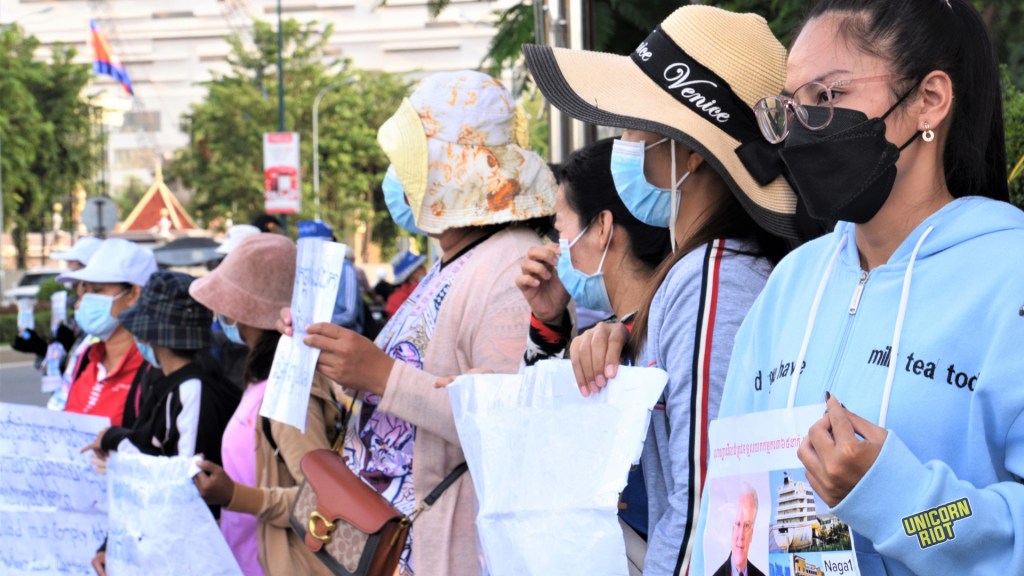
LRSU members on the picket line in front of NagaWorld2 on August 27, 2022. The sidewalk in front of the building is a sort of hallowed ground: it took months of collective action in the streets to push the authorities to concede this contested land.
In order to sustain such a long strike, workers set up a strike fund as donations large and small poured in from across the country and around the world. Other unions and human rights groups in Cambodia have fiercely supported the striking workers. Unions around the world, from the International Trade Union Confederation to the radical Industrial Workers of the World have delivered statements and funds to support the LRSU.
But in January 2023, a $5,050 transfer sent to the strike fund’s ABA Bank account from Australian feminist group Urgent Action Fund was blocked by the bank. An ABA spokesperson justified this move, saying that there was “negative news about NagaWorld,” and that there were concerns over “money laundering”despite no evidence of this taking place.
“This case really impacts workers because this money will support them while everyone doesn’t have any income,” said Ry Sovandy. “This is humanitarian support. We got the money to buy food to support strikers. If we cannot get this support, the strikers won’t be able to even buy rice.” Despite these new hardships, workers are refusing to end the strike.
Not a day goes by that Beanrun David does not feel distressed. “I’m worried because I don’t know when they can solve our problem because it has been a long time already. But I’m telling myself I can’t give up. If I give up, it would set a bad example for workers,” said Beanrun. He also thought that if the workers gave up, then other companies would replicate the violent union busting measures NagaWorld utilized on their own employees. “I have to keep going no matter how starving we are.”
The NagaWorld strike is an anomaly. Strikes simply do not last this long in Cambodia. They are often a day or two day affair which are quickly suppressed by authorities.
Khun Tharo of the Center for Alliance of Labor and Human Rights (CENTRAL), a Cambodian organization that assists workers and human rights activists, had much to say about the unique nature of the NagaWorld strike. “I would say, yes, in the history of the Cambodian labor movement, this is the longest tentative strike.”
“There are a lot of elements why the strike lasts so long: the principles of unionism, creating a strong solidarity among membership and what the workers want to receive, and their resistance, and courage not to conform,” he said. “Very early on, union members knew just how powerful of an employer NagaWorld is, and how difficult the strike would be. They were well prepared for the struggle ahead,” he said.
“I think the union at NagaWorld is very unique in terms of the workers and members and activists. They are very empowered in terms of their basic fundamental rights, and the union members are strongly educated,” said Khun. “Their strategy of resistance, nonviolence and waging a peaceful strike is well informed.”
The major question that looms is whether or not the LRSU can survive the political minefield the Cambodian power structure placed in front of them. Workers are walking through that field as we speak.
Part 2
NagaWorld casino sits next to Phnom Penh’s nicest parks. It’s a short walk to some famous pagodas, the Royal Palace, and one of Prime Minister Hun Sen’s mansions. The popular attraction is a striking monument to King Sihanouk, the founding father of modern Cambodia, and a dominant political figure in the nation his entire life. Further beyond the king, in a sliver of the park cut up by main thoroughfares, sits a small and simple concrete monument with withered flowers at its base. With an outstretched arm stands the likeness of Chea Vichea, former president of the Cambodian Free Trade Union (CFTU).
Chea was tragically assassinated in 2004 while reading a newspaper just blocks away from the monument. He was an outspoken critic of Hun Sen and the ruling Cambodian People’s Party (CPP), and a charismatic, militant union leader. Merely months later, CFTU union leaders Ros Sovannarith and Hy Vuthy were also assassinated. The cases were never solved, and many in Cambodia believe that Hun Sen and other high ranking CPP officials were behind the murders.
Ten years after these gruesome murders, as the labor movement continued to expand its militancy and make more bold demands, garment workers launched a massive strike. The action culminated around demands to increase the minimum wage, but it quickly spread, and pulled in thousands of other workers and supporters into Phnom Penh streets. The strike was drowned in blood when at least four workers were killed by police (one 14 year old garment worker simply disappeared but witnesses claimed he was shot).
This very recent history is a constant reminder of just how frighteningly perilous things can get for union activists who organize, fight for workers’ rights, and dare criticize the ruling elite. At NagaWorld members of the Labor Rights Supported Union of Khmer Employees at NagaWorld (LRSU) have been on strike since December 2021. The union has been subjected to a torrent of abuse from the casino and the authorities. The entire union leadership is facing incitement charges, and a once mass strike has dwindled down to a much smaller but determined protest. This is also happening, however, in an environment businesses like NagaWorld are able to thrive in.

LRSU members start to head home after a long day on the picket line in the sweltering heat. They escape the shadows of NagaWorld 1 but the presence of NagaWorld 2 looms before them. With a third building under construction, the domineering presence of NagaWorld is inescapable in Phnom Penh.
To say that CEO Chen Lip Keong of NagaCorp, the parent company of NagaWorld, has had a very good year would be an understatement. A perfect arrangement of political and corporate power within Cambodia’s ruling elite, and kickbacks for international capital have created a financial windfall for the CEO. With a net worth of $2.8 billion, Keong, a citizen of Malaysia, is one of the richest men in the world, according to Forbes.
The staggering revenue and profits of NagaCorp speak to a wildly different reality from the company’s public claims of financial duress, which was used to justify the mass terminations of workers. While the company’s $16 million profit in 2021 was far below their astonishing $390 million pre-pandemic profit and $1.7 billion gross gaming revenue in 2019, NagaCorp has since recovered. The gaming giant rebounded in 2022 with $445.9 million in gross gaming revenue and a $107.3 million profit. These stunning gains occurred during the height of union-busting.
The Cambodian government has gone to great lengths to assist Keong’s rush to maximize profits, awarding Keong monopoly control in the gaming market in Phnom Penh until 2045. In addition to the considerable kickbacks he gets from the government, NagaCorp is registered offshore in the Cayman Islands. Chen Lip Keong’s business practices were revealed in the Pandora Papers, which showed how Keong and other billionaires make immense profits through corporate tax havens like the Caymans.
This, coupled with an enthusiastic blessing from Hun Sen’s government, and the bidding of the Cambodian police force and legal system to crush the LRSU, was the perfect recipe to assist Keong to enrich himself to epic proportions. Few people in Cambodia have made their fortunes from an arrangement quite like the one afforded to Keong. With little standing in his way to make even more profit, the construction of NagaWorld 3 is well underway. A mass eviction of tenants was carried out to make way for what will be Cambodia’s tallest building when completed, with a stunning $3.5 billion price tag.
The Cambodian government, under the authoritarian leadership of Hun Sen and the ruling CPP, has created a capitalist paradise not just for Keong and NagaWorld, but for big businesses and the super-rich more generally. Cambodia’s economy is an extractive one and it is only through an intense exploitation of Cambodian labor and resources that foreign capitalists and politicians are enabled to amass such incredible fortunes.

Billionaire CEO of NagaCorp, Chen Lip Keong – photo via theedgemarkets.
Resistance to the fleecing of Cambodia exists on many fronts. LRSU members find common cause with the movement of land and forest defenders in the country. This movement is self-organized by common people who are resisting the wholesale destruction of Cambodia’s forests. It’s common practice for the Cambodian government to grant large swaths of land to CPP officials, big businesses, and other rich elites. The violent mass displacement of farmers and poor people, and clear-cutting of the forests and land they live off of has been essential in the consolidation of more land into the hands of the rich.
The population has not gone along with this willingly, as LRSU members attest.
“This Continues to Deteriorate” – A Dire Human Rights Situation
Hun Sen, who is a former Khmer Rouge defector, has stayed in power for 38 years. In that time he oversaw the transition from an authoritarian Communist government to a visceral embrace of capitalism and authoritarian conservatism. He has overturned elections, banned opposition parties, and filled Cambodia’s prisons with political prisoners. Although some semblance of political dissent is allowed by the government, it is heavily restrained, and at times bloodily repressed.
The government attack on the LRSU and their strike is the latest in a long line of repression aimed at undermining the labor movement. In anticipation of the national elections, which will be held in July, Hun Sen’s government has taken an even deeper plunge into the abyss of authoritarianism: repression against unions and the political opposition, and anyone who dares to criticize the ruling party and wealthy elite, has escalated.
The latest target from this increased authoritarianism is the main opposition party, the Candlelight Party, which is now effectively banned by the National Election Council from running in the upcoming election.
“I think this is a very critical situation leading up to the upcoming election,” said Khun Tharo of the Center for Alliance of Labor and Human Rights (CENTRAL). “Threats and arrests of the political opposition, and of labor, human, and environmental rights activists, and an escalation of violence is what’s going to happen before the elections.” Khun said that these issues, and the attacks on independent media, all point to a larger systemic problem, and an accelerated deterioration of fundamental rights in Cambodia.
One development that has human rights organizations concerned is the rapidly increasing population of political prisoners in Cambodia. In 2022, the government conducted a series of mass trials of over 100 opposition party members, many of whom were convicted on charges of incitement and conspiracy.
The number of political prisoners in the country jumped after the mass trial and conviction of 36 opposition members. In March, opposition activist Kem Sokha was sentenced to 27 years house arrest over fabricated treason charges. Kem is the former president of the Cambodian National Rescue Party, an opposition party that is currently banned, and founder of the Cambodian Center for Human Rights.
Other political prisoners include an array of labor, environmental, and human rights activists, land defenders, and journalists. One notable former political prisoner is 24-year-old Kea Sokhun who was sent to prison in 2022 for making music critical of the government. He recently found himself in the CPP’s crosshairs for releasing a rap video called Workers Blood which recounts a 2014 mass garment worker strike and protests.
Yet another major blow to the LRSU and other dissidents was the sudden shuttering of the fiercely independent news organization Voice of Democracy, or VOD for short. VOD took the lead among Cambodian media organizations in providing extensive coverage to the LRSU and the strike at NagaWorld. Union members considered the news organization to be a powerful ally to the union’s quest for justice.
Beanrun David lamented the government shutdown of VOD. “They covered the truth in our current society and about us too. Why should VOD be closed down?” He speculated that VOD was shut down because “the government is scared of the facts.” VOD is one of several critical news groups that had its license revoked in a move that mirrors an intense government attack on the media in the lead up to the last national elections in 2016.
At the center of the VOD controversy was a published story that detailed the Prime Minister’s son, Hun Manet, signing an aid agreement with Turkey, an act viewed by experts as sitting far outside his realm of official duties. Hun Manet is a West Point graduate and commander of the Royal Cambodian Army.
Hun Sen will eventually retire from politics. He has already spoken publicly about his desire to transfer the reins of power to Hun Manet. Heightened political repression in the lead-up to elections is nothing new in Cambodia, but if a potential transition of power is on the horizon, and there is at least discussion of such, this sheds some light on the current state of affairs.
No Justice in Politicized Courts
In November 2022 Human Rights Watch published a scathing report on the Cambodian government’s attack on unions. The report cites that the government has reserved its most fervent attacks against independent unions, and leaves the “instant-noodle” or yellow unions connected to the CPP free to do as they please. These attacks occur through a myriad of approaches that include “threats, intimidation, and criminal prosecution and imprisonment, as well as other forms of harassment.”
A series of laws created to erode workers’ rights, such as the 2016 Law on Trade Unions, and an intensified prosecution of union leaders and activists through CPP-controlled and politicized courts have taken much of the wind out of the sails of a militant, creative labor movement that took the country by storm in the early 2000s.
A common practice of the courts has been to hold charges over union leaders for an incredibly long period of time, and drag out court procedures. This leaves union leaders, and their unions, concerned that they will face additional criminal charges if they further participate in collective action. It’s a perpetual political and legal limbo.
This is precisely what happened to the LRSU leaders and activists who are facing charges. Afraid that they may end up in prison again, some of the charged have stayed away from the protests.
Human Rights Watch reported that “authorities and employers used or threatened resort to [the use of] Cambodia’s politicized criminal justice system to silence union leaders and activist members by arbitrarily arresting, detaining, and prosecuting them, or threatening to do so if union actions did not stop.”
Ry Sovandy, Chhim Sithar and the other leaders were held in prison for 74 days while they were in pretrial detention but were eventually released on bail. They were all charged with “incitement to commit felony” and accused of leading an illegal strike. CPP officials are smearing the strike as being a part of a broader plot to destabilize Cambodia. “They said we are a ‘color revolution’ group,” said Beanrun, highlighting false accusations that the LRSU is connected to nefarious foreign actors attempting to overthrow Hun Sen. “They said we are paid to protest. This is such an injustice to us,” said Beanrun.
When Chhim was out on bail, she attended a labor conference in Australia. When she returned to Cambodia, she again found herself in shackles and thrown in prison, accused of violating conditions of her parole. However, Chhim and her attorney never received any information from the court that forbade her from going to other countries.
Human Rights Watch and Amnesty International released a joint statement that said, “Sithar’s arrests reflect a pattern of a discriminatory and politically motivated retaliation by government authorities against union leaders attempting to hold the Cambodian government and corporations to account for failing to protect workers’ rights.” The two human rights groups joined a chorus of activists, unions, and governments around the world that condemned the Cambodian government and demanded Chhim’s release.
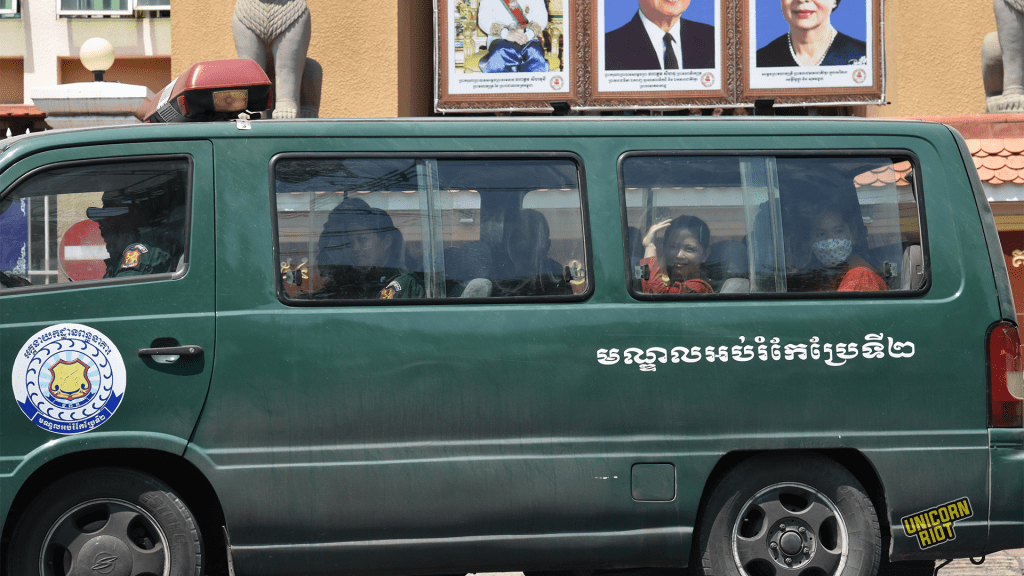
Ever defiant, LRSU union president Chimm Sithar waves to union members and supporters as she is transported from court to jail.
It has become a weekly routine for union members to protest outside court every Monday when Chhim, wearing a red prison jumpsuit and shackles on her wrists, and the other union leaders still out on bail, appear before the judge for further questioning. The judge is expected to deliver his verdict in late July but many LRSU members feel the die is already cast.
Ry Sovandy is worried about a future prison sentence that hangs in the balance, and stated that the judge “is only finding out information about our union meetings to find out what guilty convictions to give us. But everything we did is based on labor law. There was no solid reason to arrest us. It’s against our union rights to prevent workers from doing a peaceful strike.”
As union members anxiously await the verdicts, a solid core group of new leaders have emerged from the ranks of the union to help lead the strike forward.
The Long Road Ahead
The LRSU sits in a precarious situation. Union protests are a small fraction of the size they were when the strike started. Union leaders await the judge’s verdict and a likely prison sentence. The government and company continue to squeeze the union on every front; publicly smearing the union, blocking donations to their strike fund, unleashing police violence on the picket line, and silencing the journalists and media organizations that give them a voice. This is only expected to get worse as the country inches ever closer to the national elections.
A burning yet simple question weighs heavily on the minds of many: will the protests continue, or will they shrink into oblivion?
Khun Tharo suggested that the labor movement needs to “closely” look at the upcoming election. “I’m not that optimistic that things will improve right after the election,” he said. He cautioned labor and human rights organizations, “to use the elections as a benchmark” to see what kind of power the opposition has. At the ballot box, that power appears non-existent. “And as long as the trade union and civil rights movements are united along common issues we want to address, we need to consolidate it within Cambodia but also on an international level.”
Changes roiling the country’s garment industry and manufacturing could deepen political change. Cambodia has hardly recovered from the economic turmoil caused by the pandemic. Over 50,000 workers were laid off in the garment industry amidst 10 factory closures, out of a total of 500 factories across Cambodia that have suspended operations.
“We are in a crucial period of time,” said Khun Tharo. He pointed to the possible future suspension of the Everything But Arms (EBA) status of Cambodia by the EU and U.S. if human rights violations continue to deteriorate. If this happens, it has the potential of delivering a devastating multi-billion dollar blow to Cambodia’s economy. “Unions would have to come up with a platform if they want to address if factories close down and workers protest, and if there will be concrete actions.”
And the NagaWorld strike? Khun points to the need for increased collective action, however difficult that may be. “There are some key elements to consider on whether the strike and struggle will continue. It depends on the strength of the union, and how consolidated the membership is to take action,” said Khun.
The major strategic question that sits before the LRSU membership now is how exactly they plan to transform what today is a small and disparate protest of fired workers into a mass strike that has the ability to bend management to meet their demands. There is certainly precedent for this type of far-reaching, sustained action. In order to increase the numbers on the picket line, union activists would have to re-engage 2,000 other union members still working at the casino, and the many thousands more who are not yet in the union.
Khun added that the ultimate success of any strike is “dependent on the spirit of the resistance as well.”
Although beaten down, and terribly bruised, the spirit of the resistance of the LRSU is far from vanquished. It does not appear that Ry Sovandy, Bunrean David, and their fellow union members plan to give up any time soon, despite the vast sea of difficulties that lies before them.
To be a union activist in Cambodia is an unforgiving position. The awards are few, and the threat of repressive violence, or time in prison, is ubiquitous.
“As a unionist activist, it’s quite challenging for me. I was targeted by the company when I was fired, and even from the government as I saw through my experience when I got arrested and was sent to prison,” said Ry Sovandy. Worried about her safety and future, Ry’s family pleads with her to cease her union activism.
“But I need to sacrifice for the workers,” said Ry. “I have to be honest with the workers and stay in front to protest with the workers and face the challenge.”
Beanrun David said that the court cases of the union leaders motivate him to keep protesting. “I am worried about them. But things won’t get better, unless we keep striking until we receive a solution.”
Editors’ note: On Khmer (Cambodian) names. Names are normally written in the Khmer language with the surname first, and the given/first name last. This form was used in this article.
 MASSolidarity.org