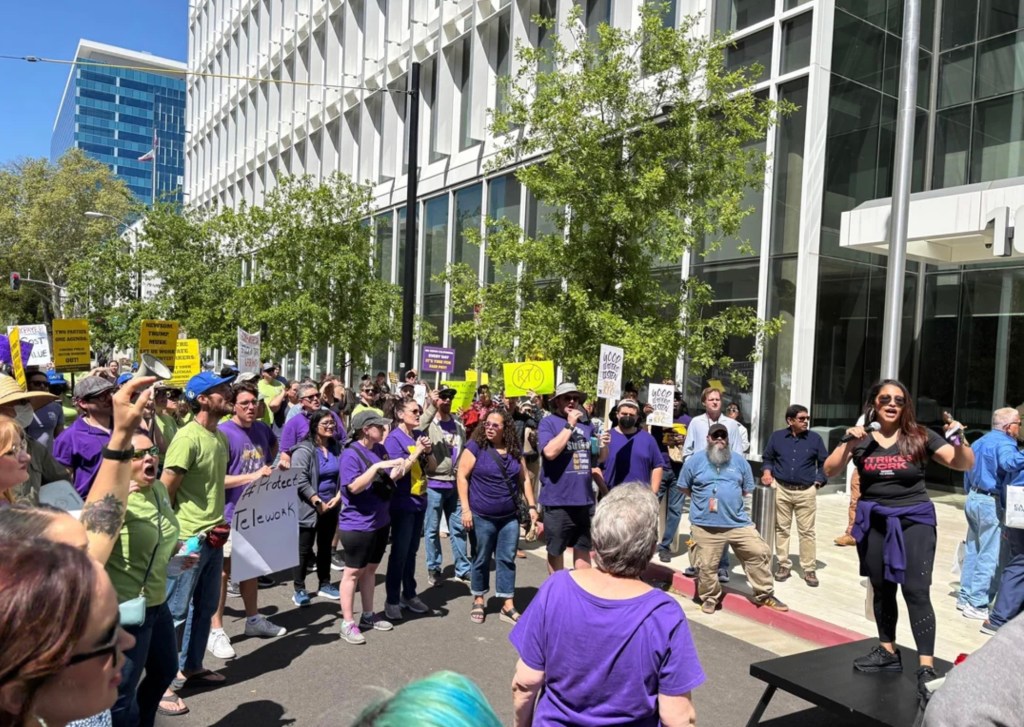
As many employers have forced workers back into offices since declaring the COVID-19 pandemic over, California’s unionized public servants successfully bucked the trend, at least for now.
A story must always start at the beginning.
In the early days of the COVID-19 pandemic, in order to protect the health of their workforce, many companies and public agencies moved to expand something that had previously existed on a smaller scale: telework, or working from home (WFH). While many workplaces are clearly not able to transition to telework, hundreds of thousands of jobs that had previously required the workers to be on-site no longer included such a requirement, and overall productivity did not suffer. In many cases, it actually improved.
In the ensuing months and years, telework became a flashpoint in a larger social context of deepening class conflict, with workers and many lower-level managers defending remote working arrangements from upper management who quickly came to see it as a concession that allows workers too much autonomy. Naturally, opinions were not always split cleanly by rank or title. Overall, however, few workers who got to work from home wanted to come back into offices much, if at all, and many, if not most, upper-level managers or executives soured on working from home being a long-term arrangement (except, in some notable cases, for themselves).
Working from home is, in many ways, an enviable arrangement compared to having to show up in-person to work every day. It allows people to get up later in the morning, spend less time commuting, spend more time with their families and pets, and be less exhausted all the time.
At first glance, the wider working class, most of whom must, by definition, be at a physical workplace in order to work, are not affected by other workers working from home or not. If anything, perhaps this majority could be motivated to lash out against such arrangements for other workers out of resentment, thereby serving a useful role for the exploiting class. However, upon closer examination, having a significant portion of workers work from home has several society-wide benefits, including:
- Less road traffic and vehicle pollution
- More parking available in key urban areas
- Increased safety due to neighborhood presence
- Reduced burdens on child and elder care systems
- More time and money to patronize gyms, theaters, etc.
Of course, nobody should forget the still-relevant original purpose of telework policies either: preventing people from catching and spreading a potentially debilitating and deadly disease.
The arrangements for different sets of workers were different. Some had full telework, some never had it, but roughly half the total state workforce had telework for at least a few days per week. In 2024, Newsom mandated at least 2 days per week in the office for all civil service workers who could reasonably make it into an office. Despite being a clear trial-balloon for a full return to office, this drew little public pushback beyond grumbles and a funny and informative website about how Newsom loves traffic, undoubtedly made by some prescient civil service workers. Conversations were starting to happen.
In attempting to claw back telework and impose a return to office (RTO), Newsom and other RTO supporters in the upper echelons of the state civil service ran up against a familiar social-historical dynamic: people will fight much harder against something being taken away than they will to get something they’ve never had before. As in other cases, such as attacks on Social Security, or Winston Churchill’s attempt to roll back wartime single-payer healthcare in Britain after the end of World War Two, the clawing back of telework arrangements has faced strong headwinds and delays due to determined mass opposition from workers.
The Battle Lines are Drawn
On March 3rd, 2025, Gavin Newsom released another RTO executive order, this time moving the number of mandatory in-office days from 2 per week to 4. The reaction to this order, compared to the previous 2-day order, was night and day. State workers were furious. But unlike many workers who had been forced back into the office, they were not only furious, they were also organized and unionized.
From the outset, a surprisingly practical hub for unified resistance to the RTO order was the reddit forum r/CAStateWorkers. On this public forum, state workers went far beyond agitating one another over the issue – they developed a shared language of resistance complete with both internal references and outward facing talking points – and shared useful information with each other in real-time. In fact, one of the most effective and unexpected tactics against the order was developed and funded via this public communications hub: the billboards.
Anti-RTO billboards, crowdfunded to the tune of $30,000 by state workers, went up along Sacramento freeways within weeks of the order, generating angry phone calls from the public about mandating more traffic. This move was both expertly timed and unexpected, catching Newsom flat-footed just as he was beginning to pivot back to trying to brand himself as a “progressive.”
However, the most formidable aspect of the opposition to RTO stems from the fact that it is taking place among unionized state workers. The unions involved are:
- Public Engineers in California Government (PECG)
- California Association of Public Scientists (CAPS-UAW)
- AFSCME 2620, health and social service professionals
- California Attorneys, Administrative Law Judges, and Hearing Officers in State Employment (CASE)
- Service Employees International Union (SEIU) Local 1000
These unions have over 80,000 members total, but represent over 120,000 at the bargaining table, 90,000 of whom reside in the greater Sacramento metro area. The largest of the unions by far is SEIU 1000, but the political sway of the others, particularly CASE, is nothing to scoff at.
RTO backers had reason to hope that the workers represented by SEIU 1000, over half of which are not eligible for telework, might begin to fight each other rather than them. If this was something they hoped for, they were soon disappointed. For one thing, civil service workers are more than capable of understanding that telework jobs existing benefits everyone. Such working conditions existing means that even state workers who don’t telework now one day could. Additionally, deft member-organizers were quick to organize natural 5-day in-office allies such as janitors, who would have a lot more work on their hands in the event of a full return to office. Other 5-day in-person SEIU members, such as local DMV staff and administrative prison staff, have other pressing issues to worry about than whether someone else is teleworking.
SEIU 1000 also is due for a new contract on exactly the same day that RTO is due to come into effect: July 1st, 2025. Although California state workers never struck until 2023, that precedent was broken by CAPS (which is majority women), who struck for three days as they were being stonewalled by the state on pay parity with their PECG colleagues (who are mostly men). It is difficult to overstate the impact that a strike by SEIU 1000 could have. The full impact it would have is unknowable, since it has never happened before.
However, Newsom did not issue this order because working in-person is what he personally believes in. For one thing, he abruptly moved his family from Sacramento to Marin a few years ago and now teleworks regularly himself. Hypocrisy aside, Newsom is clearly doing what he and those like him always do: acting on behalf of his donors and other aligned capital interests.
Specifically, the downtown Sacramento business association has clearly been lobbying hard for RTO. California’s Lieutenant Governor, Elena Kounalakis, is also known to have direct family financial interests in the value of downtown Sacramento real estate, including specific buildings leased to the State. If laws were applied consistently, this would be cause for a corruption investigation. As things stand, it is a clear example of how laws are not equally enforced.
Much of the corporate-owned and even public media in the Sacramento region have framed the labor dispute in terms that portray the unions as “special interests” but the needs of downtown businesses as the public interest. Sacramento Bee published a particular pro-RTO op-ed that was written to sound like it was from a normal, everyman worker who believed showing up in-person was just part of a good work ethic, when in fact this op-ed’s author was also a co-author of Project 2025. The Bee shamefully failed to disclose this highly relevant information to their readers, but it was exposed by the denizens of r/CAStateWorkers.
Although disappointing, this kind of coverage is consistent with many labor fights that are either not covered by the mainstream press at all, or are falsely framed in terms of workers and their unions disrupting an imagined harmony between social classes. Workers find ways to win anyway, even when the press succeeds in making their cause unpopular.
The convoluted, anti-labor coverage that frames state worker unions as “too powerful” or “protecting lazy workers,” and downtown business owners as meek victims in need of rescue is essential to obscuring what this conflict actually is: a fight between workers and owners, just like every other labor battle. Small business owners are convenient public poster children for the anti-labor side, but in reality, many downtown businesses are not actually small, and the most powerful private interests demanding RTO are big downtown property owners that those businesses pay (exorbitant) rent to.
The Stupidity of RTO
Although it may not be as bad as rush hour in Los Angeles, the Sacramento metro area also struggles with traffic. This issue was noticeably alleviated somewhat when the State switched largely to telework during the height of the COVID-19 pandemic, and the CA Department of General Services (DGS) even put up an online dashboard tracking how much harmful CO2 emissions were saved by the policy. However, the telework compliance office that ran this tracker was stripped of funding months ahead of the order itself, and the tracker was taken down when RTO was announced. In an era when every bit of emission prevention counts towards the goal of protecting our shared biosphere from collapse, which Newsom, a father, purports to care about, this particular consideration makes the RTO order completely unforgivable, and a universal issue.
In the order itself, it says that the goal is in-person collaboration. However, many teams of state workers are split between multiple physical offices, some even across cities. Therefore, the real choice is not between remote meetings and a highly questionable, idealized vision of in-person collaboration, but rather, between remote meetings held between homes and offices and remote meetings held just between offices.
The order was rolled out in such a haphazard way that confusion reigned for days, with several state agencies that have their own elected heads having to clarify that such executive orders do not apply to them. Some of these chose to announce their compliance anyway, absent any legal requirement to do so, further incensing workers.
Legally speaking, the RTO order may be on shaky ground. There is a credible case to be made that it is a violation of the Dills Act, which requires that major changes to working conditions be bargained over, and cannot be imposed outside of negotiations.
Financial skepticism of RTO is also well-founded. The State Auditor’s Office put out a report finding that due to lack of office space and equipment, Newsom’s RTO order will cost an estimated $225 million per year. Newsom, for his part, had his office put out a statement saying that they disagree with the rigorously researched report – but providing no analysis or numbers of their own. This from someone who once claimed to be a champion of fiscal responsibility.
The state of California, like any employer, also needs to compete with other employers for talent. It is already not offering competitive salaries to many in CAPS, and many in the other unions also do not lack other job opportunities. Workers who said, whether on r/CAStateWorkers or in front of legislators, that they would leave the civil service if RTO went through, were not making idle threats. Some with highly desired skillsets have already left just in preemptive anticipation of it.
Lack of proper space and equipment is a also genuine issue. In the preparations for RTO, many state offices have had to painstakingly resize cubicles one by one to make room for more in finite space. Previously useful rooms in state office buildings are now piled full of office equipment that was ordered unnecessarily.
The Boss Blinks
After weeks of large worker rallies against the order, upset calls to his office, packed legislative hearings in which state workers gave public comment against the move, overall bad publicity and public scrutiny, a decision was made to postpone the return to office until a year after its original intended date; from July 1st 2025 to July 1st 2026. Many found this surprising, but longtime labor organizers were not among them. Authority always tries to project a sense of inevitability as a way to wear down its targets. However, in labor struggles, management holding out until the very last minute before giving in is a well-known style of negotiating.
Civil service supervisors, who were clearly instructed not to comment on such matters in the presence of the supervised, expressed relief. Even if they hadn’t done so, their true feelings are ascertainable from the length of their commute and if they spend the minimum or above minimum time in the office.
Newsom and his advisors could see the writing on the wall. Workers were never going to take this rollback of 5 full years of improved conditions (now 6) laying down. If the unions failed to protect telework, that did not mean everything was just going to go as planned; far from it. Workers knew who was behind this move, and there were informal blacklists of downtown businesses that were vocally in support of RTO. If it had gone into effect, this would likely have escalated into an organized “brown bag” boycott of all downtown restaurants.
There were even some murmurs of that age-old terror of exploiters: physical sabotage.
In a post-Janus Vs. AFSCME environment, voluntary membership in SEIU 1000 went up. Many on r/CAStateWorkers also stated that if their union failed to protect telework, they would quit paying dues. SEIU 1000 is still in recovery from over a decade of the most neoliberal business unionism imaginable under the tenure of former union president Yvonne Walker. Yet, far from being another blow against an already suffering labor organization, the fight against RTO ended up being exactly the shot in the arm the union needed, and right in time for the run-up to contract negotiations.
Newsom’s Gruesome Politics
Gavin Newsom began his political career as the mayor of San Francisco, perhaps best known for his support of gay marriage rights before it was widely popular. Back then, it seems he had a better instinct for not just what is popular, but what will become popular. It seems this political instinct of his became a victim of the success it afforded him.
Newsom apparently believed, as he is/was preparing to run for President in 2028, that California state workers make a good punching bag. After all, how many times in the past have politicians boosted their own careers by undermining the livelihoods of public sector workers in the name of supposed “increased efficiency” while delivering nothing of the sort? This move on Newsom’s part was clearly planned in the early months of 2025, when the United States’ normally oppositional political landscape fell relatively silent for a surreal 60 or so days, and while Trump illegally allowed a allegedly ketamine-fueled Elon Musk and a team of his most brainwashed enthusiasts access to government payroll systems (and more) under the bumbling auspices of DOGE (Department of Government Efficiency).
Newsom’s RTO order was part of a broader attempt at a response to what he, and other old-guard Democrats, thought was a rightward shift in public opinion. However, what Newsom actually ended up doing was solidifying his reputation with many state workers and other politically astute Californians as a feckless patrician bereft of ideas (let alone values) other than to parrot what seems popular at any given moment.
Having Charlie Kirk as the first guest on his new podcast mere days after his RTO order didn’t help Newsom much either, nor did his capitulation to Kirk in the same episode on the conservative non-issue culture war bugaboo of trans women in sports. Far from setting him up as a “reasonable centrist,” this earned him scorn from the budding popular resistance to Trumpism at the time.
Politicians love a reliable voting bloc, and that is pretty much the only reason why any of them ever lend support to organized labor. For the most part, however, social movements, even the labor movement, remain deeply misunderstood by elites. In seeking to muster legitimate social anger for their own ends, members of the ruling class have often ended up with more than they bargained for. However, at a time when anger and resentment permeate society, as it does in today’s “United” States, a politician not trying to appear as a “populist” of some sort or other is pretty much admitting that they look down on most people. Therefore, in order for the ruling class to maintain power, social anger must be directed inwards at other oppressed and exploited groups. It’s a tale as old as class hierarchy itself; in times of worsening material conditions, only scapegoats can save the rulers from the wrath of the people.
Newsom’s ugly idea of “populism” was put on display when he personally helped throw away the belongings of already dispossessed Los Angeles residents. This public, physical attack on the meagre property of the poorest Californians was symbolic of an overall policy of attacking the ability of homeless people to safely exist in public. There is a longstanding emphasis of policing in California (and beyond) on blatantly stripping unhoused people of their freedom to assemble by forcibly dispersing their relatively safe, self-sustaining encampments, regardless of where they might be. Ever since the Enclosure Acts, modes of life outside wage labor are not tolerated by the capitalist state. Of course, such action only makes unhoused people more and more isolated and vulnerable, which exacerbates the visceral visibility of the inaccessibility of housing in areas like Sacramento’s downtown. On r/CAStateWorkers, a vocal minority made it clear that not having to see or interact with unhoused people is a major reason they do not wish to be downtown more than necessary. Regardless of the knee-jerk nature of these sentiments among some state workers, it is a manifestation of the contradictions of Newsom’s profit-first policies coming back around to bite their own tail.
While all these self-inflicted wounds to Newsom’s image were rolling in, state workers were organizing. It would be very convenient for Newsom, a wealthy and powerful man by any measure, if people would buy back into the tired old narrative that civil service workers are the ones living high off the public dime. However, whether Newsom realizes it or not, those days are over. Materially, California state worker pay has not been the envy of other Sacramento area workers for quite some time. And in terms of the public mood, DOGE has left a rancid taste in everyone’s mouth when it comes to politicians scapegoating civil servants.
Although Newsom’s most recent pivot has been hiring someone who is far more social media savvy and in touch with the public mood than he is to run the flamboyant, anti-Trump Newsom Press Office twitter account, much damage has already been done. His rhetorical pivots have become not only non-credible, but predictable. His nominal refusal to back down from demanding a return-to-office for state workers, even after postponing for a year, has only increased the resentment against him. With his own actions, he has all but invited displeased state workers, particularly those affiliated to SEIU, UAW, and AFSCME to demolish his reputation with the Democratic Party base.
In a recent interview, Newsom spoke about his young son, in a text exchange, asking him not to run for President because he wants his dad to be around more. People like Gavin Newsom barely even sneeze in public without consultants first telling them how they believe it will land with the electorate. These comments of his are likely a move to make himself seem more genuine after his whiplash-inducing flip-flops from the past year. Clearly, it also sets him up to withdraw from the running for US President in 2028, should he (and his family, of course) so choose.
Nobody Can Have it All
The diverse coalition of state workers have pursued almost every conceivable angle to protect telework arrangements. A bipartisan coalition of legislators supports it. On the Republican side, it is led by an Assemblyman from the Sacramento suburbs, Josh Hoover, who deftly points out that forcing state workers into downtown will hurt local businesses in his district. On the Democratic side, Assemblyman Alex Lee from the Bay Area contends that telework is clearly the future, and will help the state compete for and retain essential talent. Together, these two have introduced a bill that would reestablish the DGS dashboard showing the efficiency of telework, and place decision making power back in the hands of agencies where it de-facto belonged prior to Newsom’s poorly considered executive orders.
However, Newsom is also known for his propensity to veto bills with which he disagrees, even slightly, and even when they are passed by veto-proof majorities. And despite its putative the branch of government closest to “the people,” the California Legislature has not overridden a Governor’s veto in almost half a century, despite having ample opportunity to do so. Although some of his vetos, such as the one blocking an explicit legal prohibition on Caste-based discrimination, are truly repugnant, an override of one of Newsom’s vetos might be seen as a humiliation for him on the national stage, which is presumably exactly why the Democratic Party controlled legislature refuses to do it.
Even though the legislature has not ever challenged Newsom’s vetos, organized labor has. Having already done so the prior year, in 2022, Newsom (a vineyard owner) was about to veto a bill to protect union ballot anonymity for California farmworkers. The United Farm Workers, in their tradition of mixing civil rights and labor tactics, did a sweltering 24-day, 335-mile summer march through the Central Valley to Sacramento, arriving to much fanfare among the Latino community. Newsom still did not relent. It took farmworkers camping out in front of the Capitol for over a week, complete with a free public concert on the West Steps from Tom Morello, for Newsom to finally relent and sign the bill into law.
Newsom and his feckless advisors would be foolish to believe that if UFW, a union of less than 5,000 at the time, can cause them that much of a headache, that tens of thousands of civil service workers can’t or won’t do the same. Even if Newsom does veto the telework bill, SEIU 1000, the largest of the five impacted unions by far, is about to enter negotiations for a new contract, with the existing one expiring on the same day that the new RTO order is supposed to go into effect. Any collective agreement must pass a member vote, and the threat to telework has all impacted state worker union members more fired up and ready to go than anything in the recent past. SEIU negotiators compromising on telework would be asking to have their tentative agreement shot down by members. With the precedent of state workers not striking having been broken by CAPS on Newsom’s watch, nothing is off the table.
Civil servants are willing to make compromises in general – this is inherent to labor negotiations – but most see 2 days or less as the reasonable compromise to be had on this issue. Certain tasks by certain workers must be done in the office. This is understood by all, and this is why a day or two in-office for certain job classifications makes sense, but Newsom has abandoned all pretense that his 4-day RTO order is about anything other than downtown business interests.
Although r/CAStateWorkers has long-since caught the eye of those its most avid users seek to oppose, and attempts to use it to dampen morale may be underway, it is no longer where most of the organizing is taking place. It was a gathering point, but no longer holds the same prominence it once did. The rebellion has flown away. The connections made there, and at the rallies and in the hearing rooms, have moved to other means of communication. The unions are all cooperating, and civil service workers even started a new unitary organization around telework specifically: the California Telework Alliance.
In less than a year, California will have a new Governor, and the future of telework is a major issue for who will secure the powerful endorsements of civil service worker unions. Although the same capital interests remain, and complacency is never wise, workers are now far more organized and galvanized than at the start, and they have formed a powerful political coalition. At this point, it seems most likely that Newsom will try to keep up appearances, project inevitability (again), but ultimately use his threat to telework as a bargaining chip to be traded away in negotiations. The pieces are still in motion, however, and nothing can be taken for granted.
Unionized civil servants, like all unionized workers, tend to fight for things that ultimately benefit everyone. Workers, when organized, have the potential to reshape society completely. This is why solidarity strikes terror in the ruling class. To prevent solidarity, our bosses want us to believe all kinds of unflattering stories about our fellow workers. They have entire media conglomerates with which to lie to us about each other while they rob us all blind. This is why it’s so important for us to tell our own stories.
 MASSolidarity.org